Children and young people under the age of 18 pay €10 for any seat at family performances.
Even before the performance, children and young people can prepare for their ballet visit in workshops together with their parents. These age-appropriate introductions offer insight into the storyline, allow them to get to know the characters, and include dancing short scenes from the piece. The workshop takes place two hours before the performance begins.
Registration required
Phone: 030 34 384-166
Email: contact@tanz-ist-klasse.de
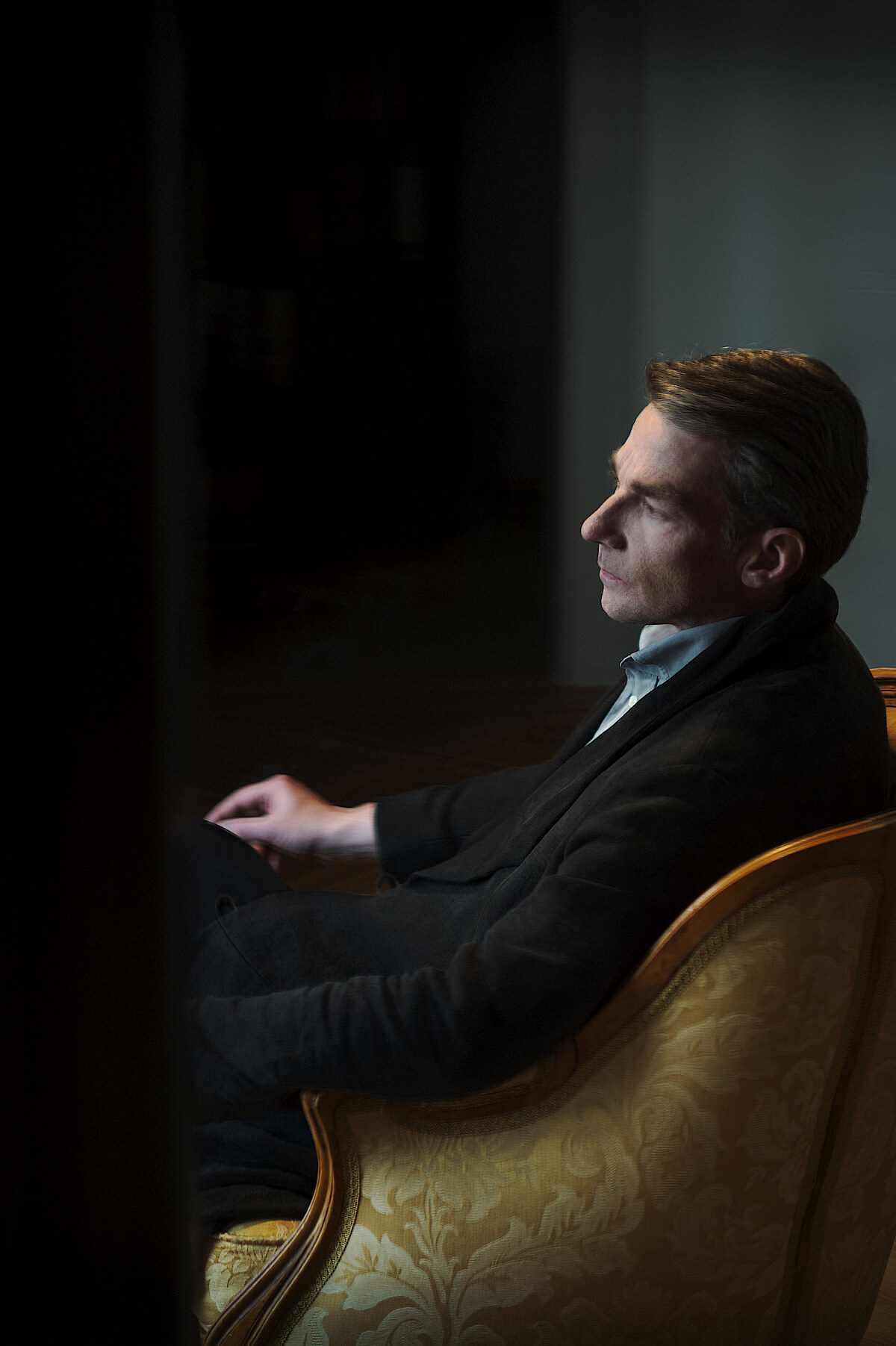
«For me, there is no love and no family without dependency.»
Marco Goecke in conversation
Christian Spuck (CS) Marco, Marguerite Duras’s novel L’Amant is a text of almost painful intensity – fragmentary, introspective and deeply melancholic. What was it about this work that touched you so profoundly that you felt compelled to turn it into a ballet?
Marco Goecke (MG) Duras has been with me for a very long time. As a teenager I would travel to Paris and sit in the Café de Flore simply because I knew she lived just around the corner. I wanted to be close to that world. Of all her works, The Lover is perhaps the most accessible – even though her language always retains something open, almost enigmatic. I’ve often wondered why no one had dared to take this material on before. It contains everything the stage needs: eroticism, violence, loneliness, family.
For me the novel was a formative read, that longing for vast, empty spaces which Duras creates in her writing, and which I am always searching for in my choreography as well.
CS The novel lives very much through language, through inner monologue and the unreliability of memory. How do you translate such an introspective world into dance when the primary tool of language is absent?
MG Language does play a role in the piece, but in a very reduced way. I use individual words and sentences very selectively. Choreography can convey states that language can no longer reach, especially when it comes to memory, desire or inner tension. There is always the risk of being misunderstood, but that risk exists in literature too. Even when words seem clear, much remains open. That openness is what interests me most. Dance can show states where language fails.
CS How closely did you follow the literary source? Was there an ambition to retell the story faithfully, and where does your own interpretation begin?
MG I actually stay very close to the novel. The locations, the temporal structure and the arc of the story are all there. Of course there are moments where I take distance, but the core remains with Duras. My aim was to tell the story physically, not to reinvent it.
CS Which themes from the novel were central for you: love, desire, dependency, memory, guilt? And what role does the colonial dimension play?
MG The colonial aspect interested me less than the dependencies between the characters. The young woman is dependent on her family, on social expectations, and at the same time on this love for an older man. For me, there is no love and no family without dependency. That is a fundamental human condition. The novel shows this very clearly and without mercy.
CS At the end of the novel there is the famous phone call from the lover many years later, when he says he has always loved her. What does this motif mean for your piece?
MG For me, that moment is the real masterstroke of the novel. Whether the phone call actually took place remains open, but with it Duras gives us hope that feelings can endure over time, even when lives drift apart. Despite all the destruction, despite money, hatred and the decades that pass, something remains. That is something we all dream of, isn’t it? The hope that love can be lasting.
That touched me deeply and is the heart of the piece for me. In my staging, the old woman appears at the end, and suddenly those decades are overcome in the blink of an eye.
CS Your musical choices for Der Liebhaber are very layered. You use music by Debussy, Ravel, Chopin, Unsuk Chin and Fauré. How did you arrive at this selection?
MG I did a lot of research when choosing the music, but I also benefited from the input of experts. Laura Berman, my artistic director in Hanover at the time, suggested some of the pieces to me. I often work very intuitively with music; I don’t listen to it endlessly in advance, but let it affect me during rehearsals. What interests me is what music triggers emotionally, not analysing it to death. For me, dance emerges from this immediate encounter.
I want to preserve a sense of openness and not pin everything down before the rehearsal process begins. Sometimes I only really start listening to the music closely while I’m working. That carries risks, for instance in terms of duration, but that uncertainty is part of the process for me. I need that spontaneity. If you overanalyse everything in advance, you lose the moment.
Taken from the 26/27 season brochure.